6 The D4 Lattice
Question. Why is D4 special?
6.1 Learning Objectives
By the end of this chapter, you should be able to:
- define
D4as the integer vectors with even coordinate sum; - test whether a four-dimensional integer vector belongs to
D4; - generate
D4points from a concrete generator matrix; - explain why the generator and parity views describe the same lattice;
- describe
D4as a union of cosets of \(2\mathbb{Z}^4\); - state the minimum distance of
D4and why it beats the integer grid at equal density.
6.2 Prerequisites
This chapter assumes integer grids, vectors, parity, generator matrices, and the lattice viewpoint from Chapter 5.
6.3 Running Example
The running scalar-quantized weight blocks are:
\[ \hat{v}_1 = (1,\;-2,\;2,\;0), \qquad \hat{v}_2 = (1,\;0,\;-2,\;3). \]
Interpretation:
- Verbal: these are the two four-coordinate blocks we have been carrying since Chapter 1.
- Geometric: each block is an integer point in four-dimensional space.
- Engineering:
D4will decide which integer points are allowed by a structured lattice rule.
Their coordinate sums are:
\[ 1 + (-2) + 2 + 0 = 1, \]
and:
\[ 1 + 0 + (-2) + 3 = 2. \]
Interpretation:
- Verbal: the first sum is odd, and the second sum is even.
- Geometric: the two blocks lie in different parity layers of \(\mathbb{Z}^4\).
- Engineering: the second block is already a
D4point; the first block must be adjusted before it can be aD4quantized point.
This chapter explains that rule. Chapter 7 will explain how to make the adjustment efficiently.
6.4 Why Not Use All of \(\mathbb{Z}^4\)?
The integer lattice \(\mathbb{Z}^4\) contains every integer vector:
\[ \mathbb{Z}^4 = \{(a_1,\;a_2,\;a_3,\;a_4) : a_i \text{ is an integer}\}. \]
Interpretation:
- Verbal: every coordinate is an integer.
- Geometric: this is the four-dimensional version of the square grid.
- Engineering: scalar rounding lands in \(\mathbb{Z}^4\).
But Chapter 5 showed that different lattice geometries give different nearest-point behavior. D4 is a structured sublattice of \(\mathbb{Z}^4\). It keeps only half the integer points:
\[ D4 = \{v \in \mathbb{Z}^4 : v_1 + v_2 + v_3 + v_4 \text{ is even}\}. \]
Interpretation:
- Verbal: a vector belongs to
D4when its coordinate sum is even. - Geometric:
D4is an alternating parity pattern inside the integer grid. - Engineering: one parity check gives a structured four-dimensional candidate set.
Figure 6.1 shows the two-dimensional slice where the last two coordinates are fixed at zero. In this slice, D4 keeps the checkerboard points with even \(v_1 + v_2\).
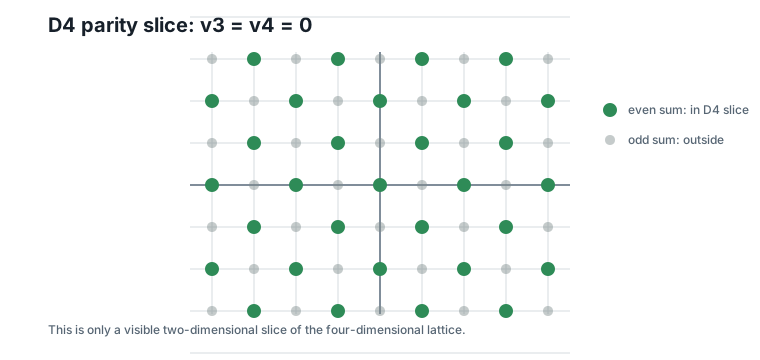
This is the first useful lattice in the book because it is simple enough to compute by hand but structured enough to be better than plain scalar rounding.
6.5 Membership by Parity
The fastest way to test D4 membership is the parity rule:
\[ v \in D4 \quad\Longleftrightarrow\quad v \in \mathbb{Z}^4 \text{ and } \sum_{i=1}^{4} v_i \equiv 0 \pmod 2. \]
Interpretation:
- Verbal: all coordinates must be integers, and the coordinate sum must be even.
- Geometric: the vector must land on an even parity layer of the integer grid.
- Engineering: membership is one integer sum and one parity check.
For the running blocks:
| Vector | Coordinate sum | In D4? |
|---|---|---|
| \((1, -2, 2, 0)\) | 1 | no |
| \((1, 0, -2, 3)\) | 2 | yes |
Figure 6.2 highlights these two cases.
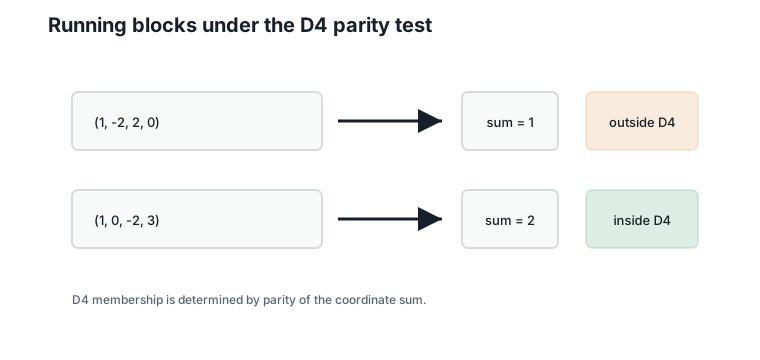
This test is also the first hint of Chapter 7. If a rounded vector has odd sum, the nearest D4 point must repair the parity by changing one coordinate.
6.6 Generator Matrix View
The parity rule is easy to test, but Chapter 5 introduced lattices through generator matrices. D4 also has a generator view.
Use the four basis vectors:
\[ g_1 = (1,\;-1,\;0,\;0), \quad g_2 = (0,\;1,\;-1,\;0), \]
\[ g_3 = (0,\;0,\;1,\;-1), \quad g_4 = (0,\;0,\;1,\;1). \]
Interpretation:
- Verbal: each basis vector has integer coordinates and even coordinate sum.
- Geometric: integer combinations of these four directions fill the
D4pattern. - Engineering: four stored basis vectors generate infinitely many
D4points.
Collect these basis vectors as columns:
\[ G = \begin{bmatrix} 1 & 0 & 0 & 0 \\ -1 & 1 & 0 & 0 \\ 0 & -1 & 1 & 1 \\ 0 & 0 & -1 & 1 \end{bmatrix}. \]
Interpretation:
- Verbal: the columns of \(G\) are \(g_1\), \(g_2\), \(g_3\), and \(g_4\).
- Geometric: multiplying \(G\) by integer coefficients walks along the
D4basis directions. - Engineering: \(G\) is a compact recipe for generating
D4points.
Figure 6.3 shows this generator-matrix view.
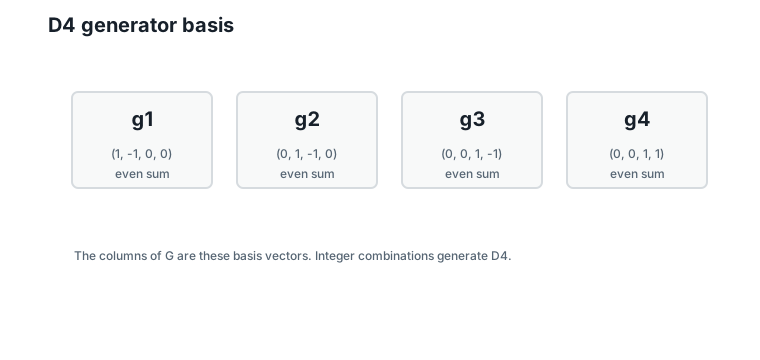
For example, choose:
\[ z = \begin{bmatrix} 1 \\ 1 \\ -2 \\ 1 \end{bmatrix}. \]
Then:
\[ Gz = \begin{bmatrix} 1 \\ 0 \\ -2 \\ 3 \end{bmatrix}. \]
Interpretation:
- Verbal: the integer coefficients generate the second running block.
- Geometric: \((1, 0, -2, 3)\) is reached by integer steps along the
D4basis. - Engineering: the vector can be represented by coefficients, not just by raw coordinates.
6.7 Why the Two Views Agree
First direction: every generator combination has even coordinate sum.
Each basis vector has even coordinate sum:
| Basis vector | Coordinate sum |
|---|---|
| \(g_1 = (1, -1, 0, 0)\) | 0 |
| \(g_2 = (0, 1, -1, 0)\) | 0 |
| \(g_3 = (0, 0, 1, -1)\) | 0 |
| \(g_4 = (0, 0, 1, 1)\) | 2 |
Any integer combination of even-sum vectors still has even sum. So every generated point is in D4.
Second direction: every even-sum integer vector can be generated.
Given:
\[ v = (v_1,\;v_2,\;v_3,\;v_4) \in D4, \]
choose:
\[ z_1 = v_1, \qquad z_2 = v_1 + v_2, \]
\[ z_4 = \frac{v_1 + v_2 + v_3 + v_4}{2}, \qquad z_3 = z_4 - v_4. \]
Interpretation:
- Verbal: the coefficients are computed directly from the target vector.
- Geometric: even coordinate sum guarantees the half-sum is an integer.
- Engineering: membership by parity and generation by \(G\) describe the same set.
Because \(v_1 + v_2 + v_3 + v_4\) is even, all four coefficients are integers. Substituting them into \(Gz\) reconstructs \(v\).
This gives two equivalent ways to think about D4:
- parity view: all integer vectors with even coordinate sum;
- generator view: all integer combinations of the four basis columns of \(G\).
6.8 Relationship with \(2\mathbb{Z}^4\)
The lattice \(2\mathbb{Z}^4\) contains integer vectors whose coordinates are all even:
\[ 2\mathbb{Z}^4 = \{(2a_1,\;2a_2,\;2a_3,\;2a_4) : a_i \text{ is an integer}\}. \]
Interpretation:
- Verbal: every coordinate is a multiple of 2.
- Geometric: \(2\mathbb{Z}^4\) is a coarser grid inside \(\mathbb{Z}^4\).
- Engineering: this grid is useful because parity labels describe which shifted copy a vector belongs to.
Every integer vector has a parity signature:
\[ (v_1,\;v_2,\;v_3,\;v_4) \bmod 2. \]
For a vector in D4, the parity signature must contain an even number of ones. There are 8 such signatures:
| Even parity signature | Example representative |
|---|---|
| \((0, 0, 0, 0)\) | \((0, 0, 0, 0)\) |
| \((1, 1, 0, 0)\) | \((1, 1, 0, 0)\) |
| \((1, 0, 1, 0)\) | \((1, 0, 1, 0)\) |
| \((1, 0, 0, 1)\) | \((1, 0, 0, 1)\) |
| \((0, 1, 1, 0)\) | \((0, 1, 1, 0)\) |
| \((0, 1, 0, 1)\) | \((0, 1, 0, 1)\) |
| \((0, 0, 1, 1)\) | \((0, 0, 1, 1)\) |
| \((1, 1, 1, 1)\) | \((1, 1, 1, 1)\) |
Interpretation:
- Verbal:
D4consists of the parity classes with even number of odd coordinates. - Geometric:
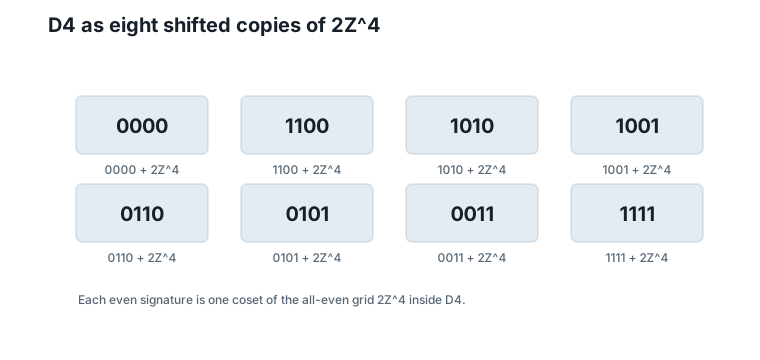
D4is eight shifted copies of the coarse grid \(2\mathbb{Z}^4\). - Engineering: parity signatures give a compact way to describe the coset structure.
Figure 6.4 shows all 16 binary signatures and highlights the 8 with even parity.
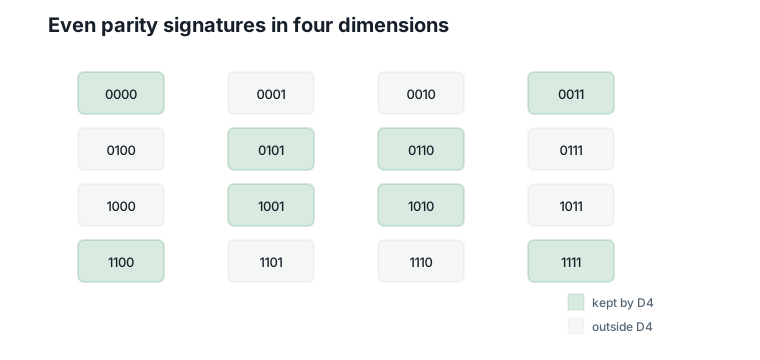
The relationship is:
\[ D4 = \bigcup_{s \in \{0,1\}^4,\;\sum_i s_i \text{ even}} (s + 2\mathbb{Z}^4). \]
Interpretation:
- Verbal: choose an even parity signature \(s\), then add any all-even vector.
- Geometric:
D4is made from eight shifted copies of the coarse lattice \(2\mathbb{Z}^4\). - Engineering: this coset view will become essential when finite codebooks appear later.
Figure 6.5 shows the coset idea as shifted copies of the even grid.
Do not confuse this with D4\(/2\)D4, which appears later and has 16 classes. This chapter is only discussing the relationship between D4 and the coarser grid \(2\mathbb{Z}^4\).
6.9 What Does D4 Buy? A First Look at Geometry
So far D4 looks like a restriction: we threw away half the integer points. The chapter’s question — why is D4 special? — deserves numbers, and Chapter 5 taught us to compare fairly, at equal density.
First, the density. The generator matrix has determinant:
\[ |\det(G)| = 2. \]
Interpretation:
- Verbal: the fundamental tile of
D4has volume 2, twice that of \(\mathbb{Z}^4\). - Geometric:
D4really does contain half the integer points — one point per volume 2 — and a nonzero determinant confirms the four basis columns are linearly independent, as Chapter 5’s definition requires. - Engineering: half the points at the same scale means one fewer bit of codebook per block, or room to rescale.
Second, the separation. A nonzero integer vector with a single \(\pm 1\) entry has odd coordinate sum, so it is not in D4. Reaching another D4 point takes at least two unit steps, and vectors like \((1, 1, 0, 0)\) achieve exactly that:
\[ \min_{v \in D4,\; v \neq 0} \|v\| = \sqrt{2}. \]
Interpretation:
- Verbal: the closest two
D4points are \(\sqrt{2} \approx 1.41\) apart, and exactly 24 neighbors sit at that distance. - Geometric: the parity constraint forbids the shortest moves of the integer grid, pushing neighbors apart.
- Engineering: larger separation at fixed density means each point can own a rounder, larger cell — lower quantization error.
Now the fair comparison. Scale \(\mathbb{Z}^4\) to the same density as D4 (volume 2 per point): the scale factor is \(2^{1/4} \approx 1.19\), so the scaled grid’s nearest points are about \(1.19\) apart. D4 achieves \(\sqrt{2} \approx 1.41\) — its points are about 19% farther apart at equal density. In fact D4 is the densest lattice packing in four dimensions (Conway and Sloane 1999), which is the precise sense in which it is special. This geometric edge, not the parity trick itself, is why D4 earns its place in the running example.
6.10 Worked Example
Classify four candidate vectors:
| Vector | Sum | In D4? |
Reason |
|---|---|---|---|
| \((1, -2, 2, 0)\) | 1 | no | odd sum |
| \((1, 0, -2, 3)\) | 2 | yes | even sum |
| \((2, -2, 2, 0)\) | 2 | yes | even sum |
| \((0, 0, 0, 0)\) | 0 | yes | even sum |
Now generate \((1, 0, -2, 3)\) from the generator matrix. The coefficient vector is:
\[ z = (1,\;1,\;-2,\;1). \]
Multiplying gives:
\[ Gz = (1,\;0,\;-2,\;3). \]
Interpretation:
- Verbal: the second running block passes both the parity test and the generator test.
- Geometric: it lies on the
D4lattice. - Engineering: this point can be used directly as a
D4representative.
The first running block fails the parity test. Chapter 7 will find its nearest D4 replacement.
6.11 Algorithms
6.11.1 Algorithm 6.1: D4 Membership Test
Input: a vector \(v\) of length 4.
Output: true if \(v\) is in D4, otherwise false.
function is_in_D4(v):
    if length(v) != 4:
        return false
    if any coordinate of v is not an integer:
        return false
    return (v[1] + v[2] + v[3] + v[4]) is even
Complexity and implementation notes:
| Property | Cost |
|---|---|
| Time | \(O(d)\), here \(d = 4\) |
| Memory | \(O(1)\) |
| Offline preprocessing | None |
| Online inference cost | One integer sum and one parity check |
| Parallelism | Coordinates can be reduced in parallel |
| GPU suitability | Excellent |
| SIMD suitability | Excellent |
| Possible optimization | Use bit parity on packed low bits |
Language note. “Is an integer” means the value is an integer, not that the variable has an integer type: the vector \((1.0,\;0,\;0,\;1)\) is in D4. In floating-point code, test integrality by value (for example, Python’s float.is_integer()), and beware that large floats lose integer precision.
6.11.2 Algorithm 6.2: Generate a D4 Point from Coefficients
Input: an integer coefficient vector \(z\) of length 4.
Output: the lattice point \(Gz\).
function generate_D4_point(z):
    G = D4 generator matrix
    return G z
Complexity and implementation notes:
| Property | Cost |
|---|---|
| Time | \(O(d^2)\) for dense matrix multiplication, or \(O(d)\) using the sparse formula |
| Memory | \(O(d)\) for the output |
| Offline preprocessing | Store the generator matrix |
| Online inference cost | Usually avoided unless coefficients are the stored representation |
| Parallelism | Coordinates are independent after coefficient reads |
| GPU suitability | Good, but direct formulas are better than dense matrix multiply |
| SIMD suitability | Good for batched coefficient vectors |
| Possible optimization | Use the explicit sparse coordinate formulas |
6.11.3 Algorithm 6.3: Parity Signature and Coset Representative
Input: an integer vector \(v\) of length 4.
Output: its modulo-2 parity signature and whether the signature is valid for D4.
function D4_parity_signature(v):
    signature = empty list
    for coordinate in v:
        append coordinate mod 2 to signature
    valid = sum(signature) is even
    return signature, valid
Complexity and implementation notes:
| Property | Cost |
|---|---|
| Time | \(O(d)\), here \(d = 4\) |
| Memory | \(O(d)\) for the signature |
| Offline preprocessing | None |
| Online inference cost | One parity bit per coordinate |
| Parallelism | Coordinates are independent |
| GPU suitability | Excellent for batched vectors |
| SIMD suitability | Excellent, especially with bit masks |
| Possible optimization | Pack the four parity bits into one nibble |
The executable reference implementation is in code/python/chapter_06_d4.py.
6.12 Engineering Insight
D4 is useful because it adds structure with almost no membership cost. Testing whether a vector is in D4 is just a parity check, but the allowed point set has measurably better geometry than the cubic grid: about 19% more separation between points at equal density, the best any four-dimensional lattice can do.
This is the kind of tradeoff that matters in quantization. We want a codebook-like set that is structured enough to decode quickly, but rich enough to reduce error. D4 is the first lattice in the book that balances those two goals.
The remaining problem is nearest-point decoding. If a rounded vector is not in D4, membership testing only tells us that it failed. It does not tell us which D4 point to use. That is the job of Chapter 7.
6.13 Historical Note and Further Reading
D4 is the four-dimensional root lattice from the D_n family. It appears throughout lattice theory, coding theory, and sphere packing, and it gives the densest lattice packing in four dimensions. For a standard reference, see Conway and Sloane (1999).
This book uses D4 first because its parity rule is simple enough to compute by hand and its dimension matches the running block size.
6.14 Exercises
6.14.1 Conceptual Exercises
- Show that the sum of two even-sum integer vectors has even sum. Why does this matter for
D4being a lattice rather than an arbitrary subset of \(\mathbb{Z}^4\)? - Why does every integer combination of the four basis vectors stay in
D4? - Why is
D4not the same as \(2\mathbb{Z}^4\)?
6.14.2 Worked Numerical Exercises
- Determine whether \((2, 1, 3, 4)\) belongs to
D4. - Determine the parity signature of \((1, 0, -2, 3)\).
- Use the coefficient formula to generate \((2, -2, 2, 0)\) from the
D4generator matrix. - List four of the 24 shortest nonzero vectors of
D4and verify that each has length \(\sqrt{2}\).
6.14.3 Programming Exercises
- Run
python code/python/chapter_06_d4.pyand confirm the membership results. - Implement a function that lists all even parity signatures of length 4.
- Pack a four-bit parity signature into one integer from 0 to 15.
6.14.4 Research Questions
- Why might a sublattice of \(\mathbb{Z}^4\) have better quantization geometry than \(\mathbb{Z}^4\) itself?
- How does the parity view of
D4resemble a binary error-correcting code? - What hardware operations make parity checks cheap?
6.15 Common Mistakes
- Confusing
D4with all of \(\mathbb{Z}^4\). - Confusing
D4with \(2\mathbb{Z}^4\). - Checking parity coordinate by coordinate instead of checking the coordinate sum.
- Thinking the membership test is the same as nearest-point decoding.
- Crediting
D4over \(\mathbb{Z}^4\) without equalizing density first.
6.16 Summary
D4 is the set of four-dimensional integer vectors with even coordinate sum. It can be understood in two equivalent ways: a parity rule and a generator matrix. It also decomposes into eight shifted copies of \(2\mathbb{Z}^4\), one for each even four-bit parity signature.
The parity constraint pays for itself geometrically: at equal density, D4 points are about 19% farther apart than integer-grid points, and no four-dimensional lattice does better. This makes D4 a compact, structured, and computationally friendly lattice for the running four-dimensional blocks.
6.17 Preview of Next Chapter
Next we turn D4 into a quantizer. The key problem is nearest-point decoding: given any real-valued vector, find the closest point in D4 without brute-force search.